MINNESOTA SPORTS FACILITIES AUTHORITY RELEASES ECONOMIC IMPACT STUDY OF U.S. BANK STADIUM
Thursday | Mar. 19, 2026
Minnesota Sports Facilities Authority Releases Economic Impact Study of U.S. Bank Stadium
New Economic Activity and Tax Benefits Exceed State Investment, Will Continue to Grow
The Minnesota Sports Facilities Authority (MSFA) today released a comprehensive economic impact study demonstrating that U.S. Bank Stadium continues to deliver substantial economic, fiscal, and community benefits for the State of Minnesota and within the City of Minneapolis. The analysis shows that public investment in the Stadium has generated billions in economic activity, supported thousands of jobs, and helped drive major redevelopment in the Downtown East neighborhood.
From 2017-2025, U.S. Bank Stadium generated $1.36 billion in new direct spending and $2.77 billion in total economic activity, serving as a “sustained economic engine” according to a study by Hunden Partners, which specializes in economic impact and large-scale development analysis. Eighty-one percent of stadium visitors come from outside Minneapolis, and one in four Stadium visitors travel from outside Minnesota for events.
“U.S. Bank Stadium serves as a world-class home for Vikings football, collegiate and high school athletics, community events, concerts headlined by national and international talent, and many more civic and cultural activities,” said Michael Vekich, MSFA Chair. “This study confirms what Minnesotans and visitors experience every year: Vikings home games and the other popular events at U.S. Bank Stadium are bringing people together to enjoy being with friends while also strengthening our area’s economy.”
The analysis evaluates the Stadium’s construction period (2013–2016), its initial operations (2017-2025), and its expected future benefits (2026–2046). It uses RIMS II, a standard economic modeling tool from the Bureau of Economic Analysis, along with detailed spending models to measure net new economic activity — benefits that are attributable to the stadium that are realized in Minneapolis and throughout the entire state.
“When measuring the ‘value’ of a public investment,” the report explains, “the relevant question is: what new spending entered the area that would not have occurred without the venue?”
The study finds that U.S. Bank Stadium has already generated $2.34 billion in total economic benefits from its construction, followed by $2.77 billion in statewide economic activity from operations through FY 2025. Over the full 30‑year term that was analyzed, statewide economic activity is projected to reach $14.2 billion, supporting an average of 2,605 jobs annually and generating $1.63 billion in state tax revenue.
The report further concludes that “The State of Minnesota will receive approximately $1.11 billion in tax revenues in excess of the State’s initial investment,” referencing the dedicated taxes authorized by the Legislature for construction of the Stadium.
To avoid overstating impact, the study only counts spending from visitors traveling into the State and City, thereby avoiding the substitution effect and ensuring that estimates of economic benefits are conservative. A location analytics platform called Placer.ai, which uses mobile data to track visitor patterns, determined that 26 percent of Stadium attendees are from out of state. For example, data shows that of the 357,000 out-of-state visitors in 2025, 82 percent stayed overnight. Overnight visitors spend an estimated $285 per trip, generating significant new activity for hotels, restaurants, and transportation providers, the report states.
“The findings make clear that the State’s investment is producing real, measurable returns,” said Vekich. “This is new spending, not a reshuffling of existing activity. Visitors who come for Vikings games, concerts, and national events are bringing new dollars into Minnesota’s economy — and those dollars ripple outward to support jobs and local businesses.”
The Stadium’s economic impact provides a unique benefit to Minneapolis, particularly the Downtown East neighborhood, with more than 800,000 attendees arriving annually from outside of the City. From FY 2017-2025, non‑resident visitors generated $3.92 billion in total economic activity for Minneapolis.
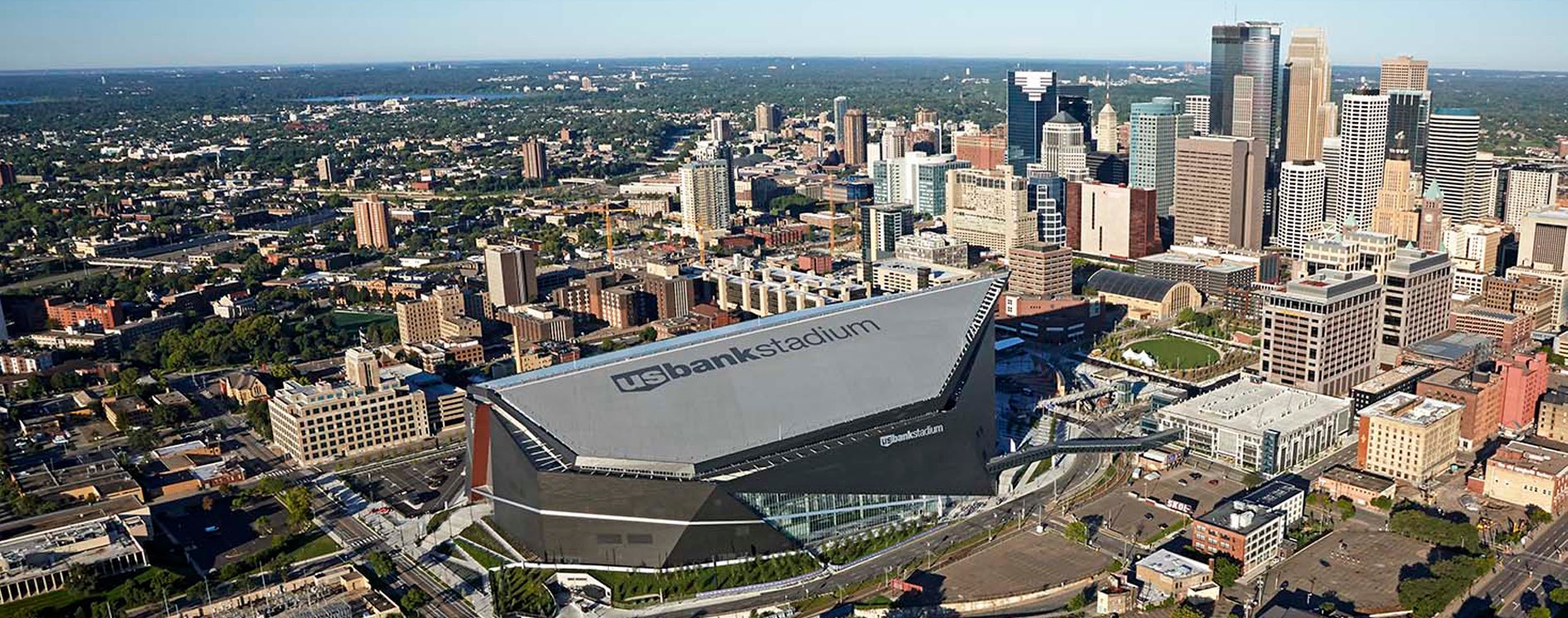
A partnership of public and private investors has also fueled the expansion of community impacts in the Downtown East neighborhood. More than 4.6 million square feet of development in offices, residences, hotels, and restaurants have been added since 2014, with $1.2 billion in direct construction spending. “Anyone who has attended a concert or athletic event at U.S. Bank Stadium sees the energy in the Downtown East neighborhood for hours both before and after,” explained Vekich.
“With continued investment and strong event programming,” the report concludes, “the Stadium will continue delivering value through the initial 2046 term.” This value includes more than 1.26 million attendees annually through 2046, continued employment of thousands, as well as significant taxes for the State of Minnesota and the City of Minneapolis.
The full economic impact study, including detailed methodology, tax analyses, and Downtown East redevelopment findings, is available from the MSFA. Visit msfa.com for additional information on the study.